Overview
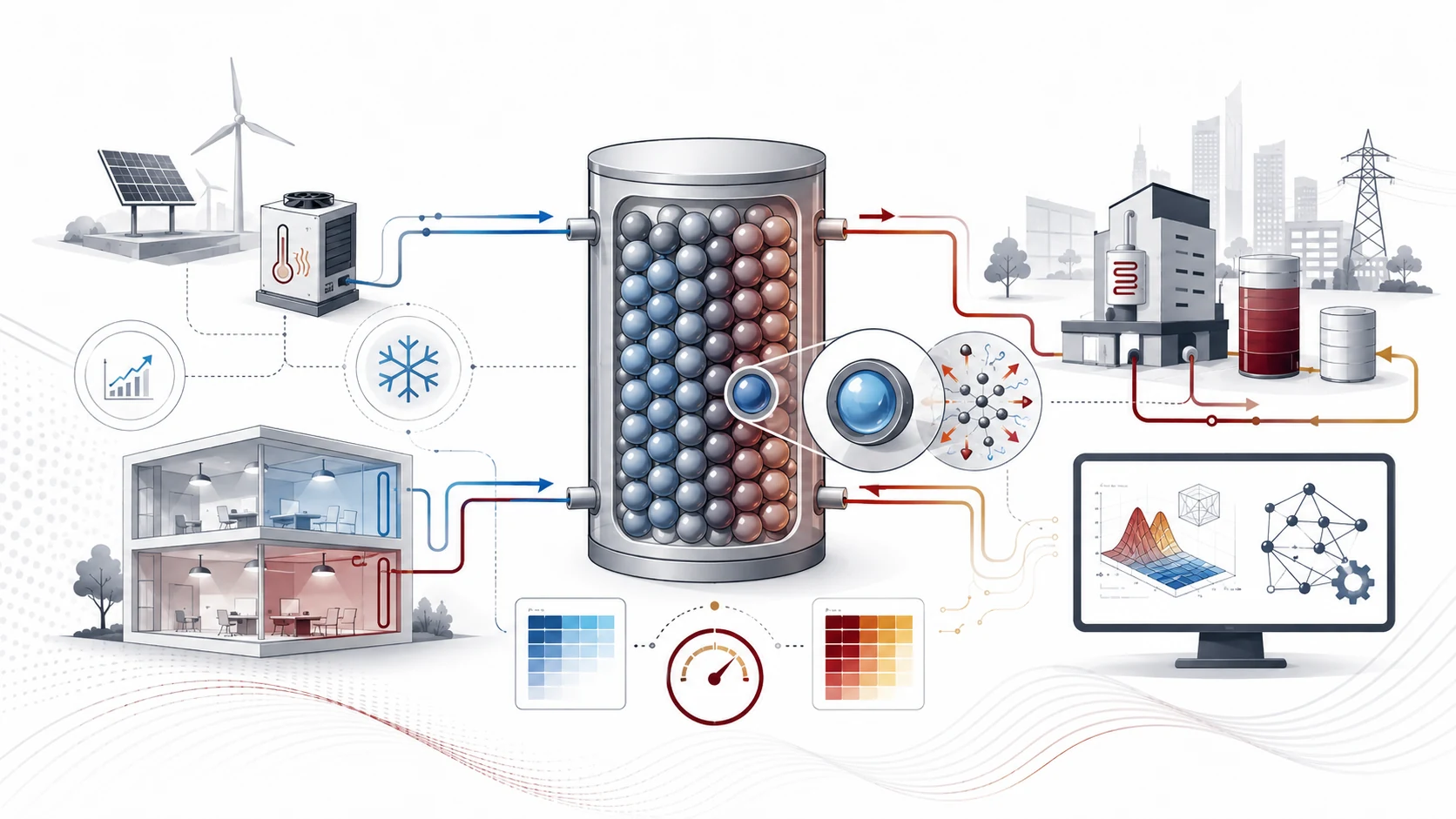
This research investigates advanced thermal energy storage systems using nano-enhanced phase-change materials (Nano-PCM) to improve thermal transport, charging and discharging performance, and system-level energy flexibility.
Thermal energy storage can support load shifting, peak reduction, resilient operation, and improved integration of energy systems. However, conventional phase-change materials are limited by relatively low thermal conductivity. The research therefore investigates nanoparticle-enhanced PCM and hybrid storage configurations to improve heat-transfer performance.
Research Approach
- Packed-bed thermal energy storage
- Encapsulated phase-change materials
- Nano-enhanced PCM
- Heat-transfer-fluid circulation
- Phase-change heat transfer
- Multiphase and porous-media transport
- Multiphysics computational modeling
- Charging and discharging prediction
- System-level performance analysis
A major focus is understanding how thermal-front evolution influences usable storage capacity, charging and discharging behavior, and overall thermal-storage effectiveness.
Computational and System Framework
The research couples heat transfer, fluid flow, and phase-change physics to predict thermal-storage behavior under transient charging and discharging conditions.
Research Direction
Future research will extend nano-enhanced thermal-storage concepts toward flexible cooling systems, resilient energy infrastructure, hybrid energy systems, and battery thermal buffering.