
Overview
This research develops high-fidelity computational approaches for understanding and controlling thermal behavior in advanced battery systems.
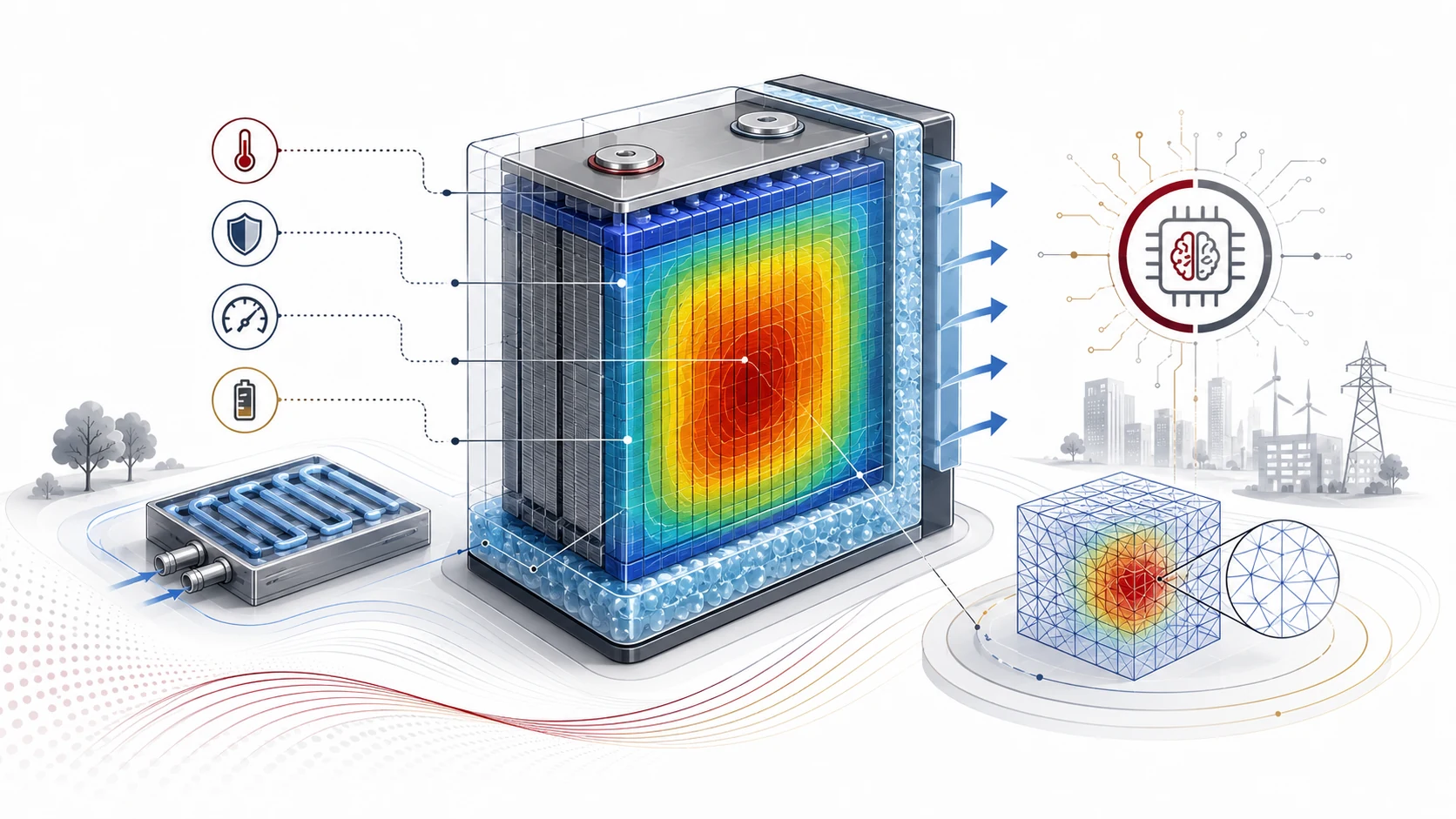
Battery performance, safety, and lifetime are strongly influenced by temperature gradients, local hot spots, and transient thermal behavior. Effective battery thermal management therefore requires models capable of resolving localized heat-transfer phenomena that may not be adequately represented by simplified system-level approaches.
Research Approach
The research uses the Finite-Volume Discrete Boltzmann Method (FVDBM) to investigate:
- Cell- and module-level thermal behavior
- Local temperature gradients
- Hot-spot formation and evolution
- Transient heat transfer
- Thermal buffering
- PCM-based thermal management
- Heat removal and cooling behavior
- Local transport physics
Current Research
Preliminary investigations examine battery–PCM configurations and the evolution of thermal gradients under transient operating conditions. The simulations show that thermal buffering can reduce temperature rise while localized transport behavior continues to govern hot-spot evolution and temperature nonuniformity.
Research Direction
The high-fidelity computational framework is intended to provide a foundation for improved battery thermal-management design, reduced-order thermal models, predictive battery-management tools, future electro-thermal integration, AI-enabled battery digital twins, and thermal management of advanced energy-storage systems.