Overview
This research develops intelligent thermal-energy management frameworks that move building and district energy systems from reactive operation toward predictive, data-enabled control.
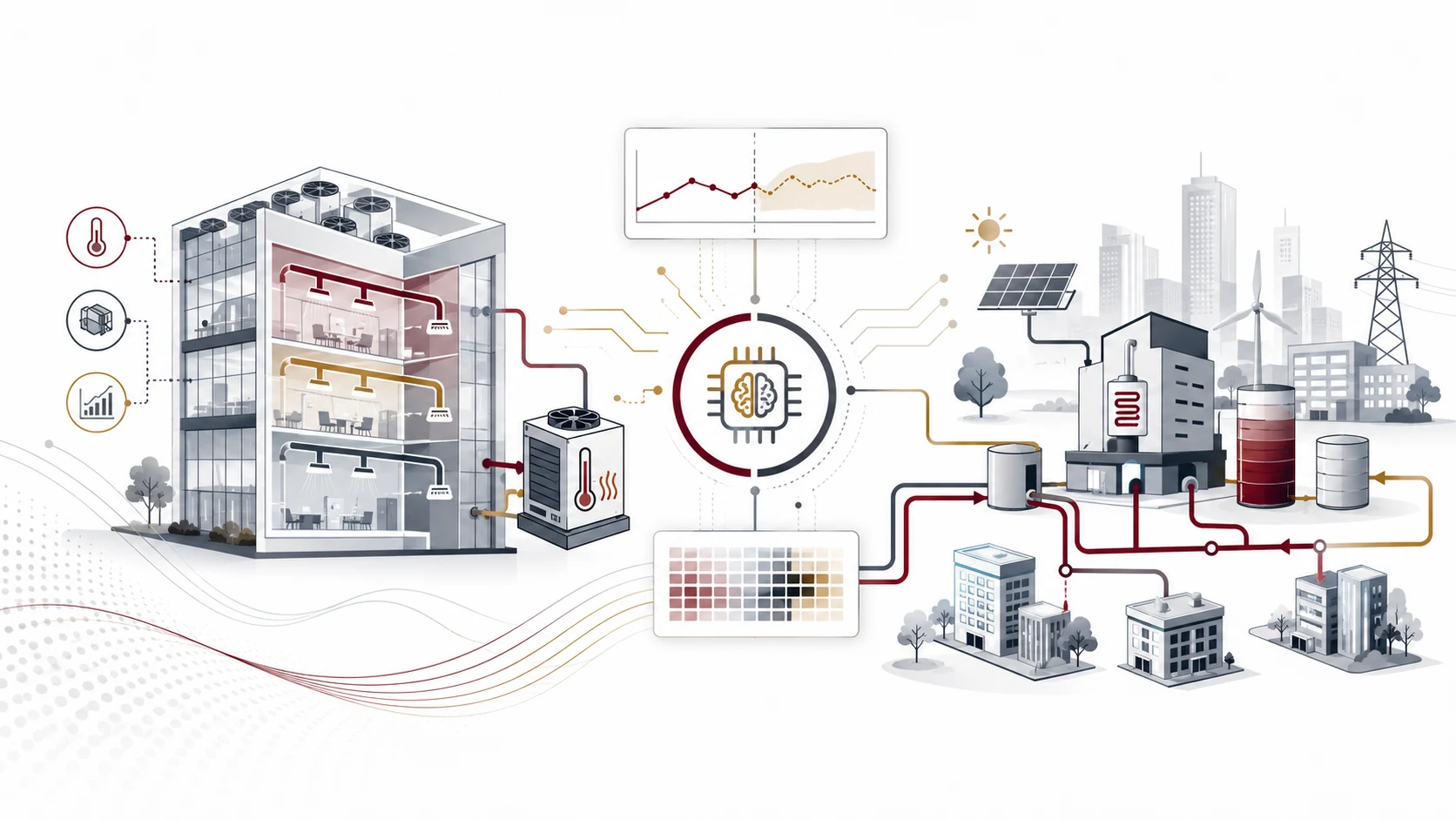
The work integrates operational measurements, weather and occupancy data, energy demand, historical system behavior, predictive modeling, thermal-state estimation, and optimization. These elements are connected to control decisions such as HVAC setpoints, thermal-storage dispatch, and plant or network operation.
The broader goal is to create scalable intelligent thermal-energy systems that connect building-level sensing and control with district- and plant-level optimization.
Research Approach
- AI-enabled cooling-load prediction
- Thermal-state estimation
- Predictive optimization and control
- Smart HVAC and micro-zonal control
- Chilled-water system optimization
- Thermal-storage dispatch
- Building-to-district energy integration
- Digital-twin development for thermal-energy systems
Demonstrated Research
A building-scale micro-zonal HVAC testbed demonstrated the potential of intelligent control for simultaneously improving thermal comfort and reducing airside energy use. The research has subsequently expanded from building-level control toward predictive cooling-load modeling, multi-chiller optimization, and district-scale thermal-energy management.
Research Direction
Current and future work focuses on integrating physics-based models, operational data, AI, and optimization into scalable digital-twin frameworks for buildings, district energy systems, and resilient energy infrastructure.